
Frequently asked questions
Garden drainage, irrigation, steel edging, patios, tree work, fencing and how we work.
Clay-Soil Drainage & Soil Improvement
How much does clay-soil drainage improvement cost?
Drainage channels typically cost £45–£90 per linear metre. Area-wide soil improvement using deep mechanical incorporation costs £15–£30 per m². The final price depends on how waterlogged the site is, access for machinery, and the depth of treatment required.
How do I know if my garden has a clay soil problem?
The clearest signs are puddles lasting more than 24 hours after rain, cracks appearing in the soil during dry summers, grass that stays patchy despite feeding, and moisture reaching the base of walls or foundations.
How long does garden drainage work take?
A smaller garden up to 50 m² usually takes 2–4 days. Larger projects with drainage channels and soakaways run 5–7 working days, and longer in wet clay during winter.
Is clay soil improvement permanent, or does it need repeating?
Mechanical incorporation of APAM, lime and organic matter into clay is a long-term treatment lasting years. On permanently waterlogged sites we recommend combining it with a drainage channel or soakaway to remove excess water.
Is APAM safe for children, pets and plants?
Yes. Anionic polyacrylamide used in soil treatment is approved for horticultural use and presents no risk to people, animals or surrounding planting when applied correctly.
Do I need permission for garden drainage work?
Standard soil improvement within your own garden does not require permission. Connecting to a public surface-water drain, or placing a soakaway within 5 metres of a building, does require approval — we check this before starting.
Will drainage work damage my existing lawn or planting?
Trenching disturbs the surface along the drainage route. We reinstate turf and planting as part of the job, and the affected strip typically recovers within one growing season.
What happens to the water once it is collected?
It must discharge to a lawful outlet — a soakaway, a lower part of the garden, or an approved surface-water drain. Discharging to a foul sewer is not permitted. We identify the outlet before quoting.
Automatic Irrigation Systems
How much does an automatic irrigation system cost?
A small single-zone system starts from £600. A typical family garden with multiple zones and a smart controller costs £1,500–£3,000. Larger or fully sensor-controlled installations run £3,000–£4,500.
Does automatic irrigation actually save water?
Yes. Smart controllers with rain or soil-moisture sensors reduce garden water consumption by 40–70% compared with hand watering, because water is delivered at the right time, in the right quantity, directly to the root zone.
How long does installation take?
A small garden with one or two zones takes 1–2 days. A larger multi-zone system with a control unit takes 3–5 days.
Does the system need to be shut down for winter?
Yes. Before the first frosts the pipework should be blown clear and the system put into winter mode to prevent burst pipes. We offer this as part of ongoing care.
Will installation destroy my existing lawn?
No. Pipework is installed using a trenching method that lifts a narrow strip of turf, which is relaid immediately. The lines are normally invisible within a few weeks.
Can the system water borders and pots as well as the lawn?
Yes. Pop-up sprinklers cover lawns while drip lines target borders, hedges, raised beds and containers. These run as separate zones so each area gets the right amount of water.
Which irrigation brands do you install?
We select components from established manufacturers — Hunter, Rain Bird, Toro, Gardena and Claber — chosen according to coverage, water flow, pressure and control requirements.
Do I need a water meter or special water supply?
Most domestic systems run from a standard mains outdoor tap. We check available flow and pressure during the site survey; where pressure is low, the system is zoned to work within it.
Pure Line Steel Edging
How much does steel garden edging cost?
From £29 per linear metre for selected installations using 6 mm profile. Thicker 8 mm and non-standard shapes are quoted individually after a site measurement.
How long does steel edging last?
Welded 6–8 mm steel installed correctly lasts decades. The surface patina that develops is an aesthetic finish, not a sign of structural corrosion.
Can steel edging be curved?
Yes. Pure Line is formed and welded on site, so it follows both regular and irregular bed and path shapes.
What is the difference between 6 mm and 8 mm steel edging?
6 mm suits most domestic borders and paths. 8 mm is used where the edging retains a level change, borders a driveway, or takes vehicle or heavy foot traffic.
How is steel edging fixed into the ground?
It is supported by welded T profiles driven into the ground at intervals, which hold the line straight and prevent movement over time.
Patios, Driveways & Hard Landscaping
How much does a new patio cost in Oxfordshire?
A complete installation including excavation, sub-base and laying costs £90–£180 per m² depending on material. Concrete slabs sit at the lower end, natural stone and porcelain at the upper end.
How long does it take to lay a 20 m² patio?
Typically 3–4 working days including sub-base preparation.
Which patio material is best for the British climate?
Porcelain needs no sealing and handles frost and damp best. Indian sandstone is cheaper but needs occasional treatment against moss and algae. We recommend based on sun exposure, use and budget.
Do I need planning permission for a patio or driveway?
A standard garden patio usually falls under permitted development. A new or enlarged front driveway using impermeable material may require consent because of surface-water rules — since 2008 new front-garden paving must drain to a permeable area rather than the public sewer. We confirm this before quoting.
What happens to the waste and excavated soil?
All waste and surplus soil is removed and disposed of in line with regulations. This is included in the quotation, never added afterwards as a hidden cost.
Why are some patio quotes so much cheaper?
The difference is almost always in the groundwork that cannot be seen — excavation depth, a properly compacted sub-base, edge restraints and drainage falls. A patio laid without these will move and crack within a few winters.
Can you clean or restore an existing patio instead of replacing it?
Yes. We offer pressure washing and controlled treatment for mineral deposits, cement residue, efflorescence, algae and staining, which often restores a sound patio at a fraction of replacement cost.
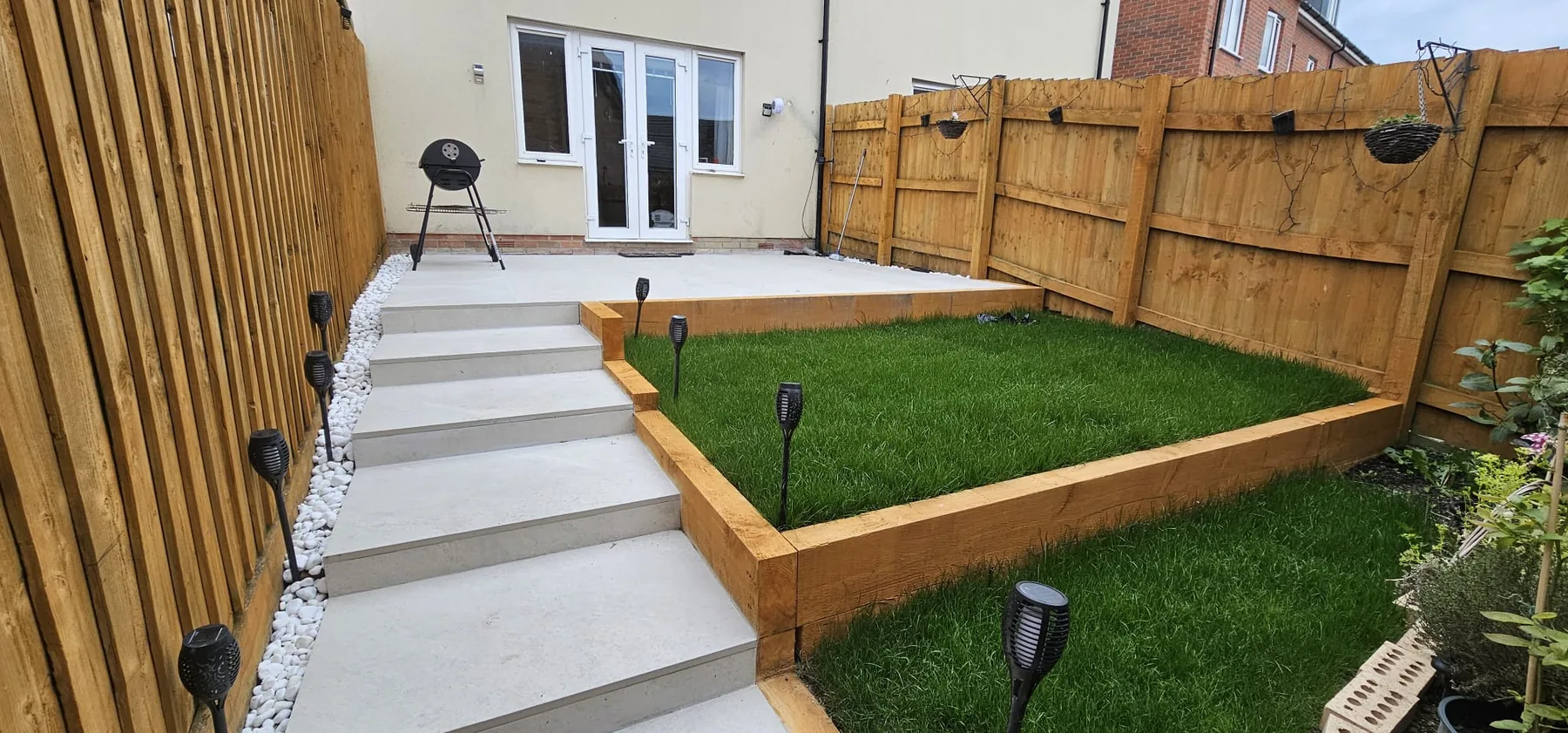
Do you build steps and deal with sloping gardens?
Yes. Level changes, steps, retaining and setting out falls for drainage are part of our hard landscaping work.
Sheds, Pergolas & Bespoke Timber Structures
Do you build garden rooms, workshops and sheds?
Yes. We build garden buildings, workshops, storage, pergolas, gazebos, benches and bespoke joinery, including hardwood furniture.
Do I need planning permission for a garden building?
Most garden buildings fall under permitted development if they are single-storey, under 2.5 m high where within 2 m of a boundary, and cover no more than half the garden area. Conservation areas and listed properties have tighter rules — we check before starting.
Can you build a soundproofed garden room?
Yes. We have extensive experience constructing soundproof garden houses achieving noise reduction of up to approximately 50 dB — suitable for music rooms, home studios and offices near busy roads.
Do garden buildings need a concrete base?
Not always. The base depends on the size, weight and intended use of the building. We assess ground conditions and specify an appropriate foundation, which on clay soils often needs more attention than on free-draining ground.
Tree Surgery & Arboriculture
How much does tree pruning or removal cost?
Smaller pruning work starts from £150. Removing a small tree costs £240–£550. Large or difficult-access trees run £800–£2,500 or more. Stump grinding is £100–£400. Exact pricing follows a site visit, as size, species and access change the scope significantly.
When is the best time of year for tree work?
Deciduous trees are best pruned between November and March while dormant. Bird nesting season (March–August) restricts work by law — we check for active nests before starting. Some species such as cherry and plum are better pruned in summer to reduce disease risk.
Do I need permission to prune or fell a tree?
Yes, if the tree is covered by a Tree Preservation Order (TPO) or stands in a Conservation Area. We check the status with the local authority before any work begins, which avoids the risk of a fine.
Are you insured and qualified for climbing work?
Yes. Public liability insurance and certification for chainsaw use and climbing are standard, and documentation is available on request.
What happens to the timber and brash afterwards?
Removal and disposal of woodchip and timber is included in the price, unless you would like to keep the wood for firewood.
Can a tree be reduced instead of removed?
Often yes. Crown reduction, thinning or pollarding can solve light, size or safety concerns while keeping the tree. We advise which option suits the species and situation.
Fencing, Gates & Boundaries
How much does new garden fencing cost?
Complete installation including materials and labour costs £70–£150 per linear metre depending on type — panel, feather-edge, slatted or metal. Removal and disposal of an old fence adds £4–£8 per metre.
How high can I build a fence without permission?
Generally up to 2 metres, or 1 metre where the fence adjoins a public highway. Taller fencing, or property in a conservation area, may require consent.
Should I discuss the boundary with my neighbour first?
We strongly recommend it, particularly where the fence replaces a shared boundary. It is not always legally required, but it avoids disputes later.
How long does a timber fence last?
Well-treated timber with concrete posts lasts 15–20 years. Standard panels with timber posts last closer to 8–12 years depending on exposure to rain and wind.
Are concrete posts worth the extra cost?
Usually yes. They resist rot completely and typically last 20–30 years, so although they add to the upfront price they reduce long-term replacement cost.
Garden Maintenance & Hedge Care
Do you offer regular garden maintenance?
Yes — mowing, pruning, seasonal clearance, hedge cutting and ongoing garden management on a regular schedule.
How often should hedges be cut?
Most formal hedges need two cuts per year, typically late spring and late summer. Fast-growing species such as leylandii may need three. Nesting season restrictions apply between March and August.
Do you offer one-off garden clearances?
Yes, including overgrown gardens, end-of-tenancy clearances and site preparation before landscaping work.
Working With Us — Process, Payment & Guarantees
Which areas do you cover?
Oxfordshire and Berkshire, including Didcot, Oxford, Abingdon, Wallingford, Reading and Newbury and the surrounding areas.
Do you provide free written quotations?
Yes. Send photographs, approximate dimensions and your postcode and we will prepare a free written quotation. Larger projects include a site visit first.
How does the process work from enquiry to completion?
Enquiry with photos, dimensions and postcode → site visit for larger projects → written quotation with agreed scope → agreed start date → work carried out → handover and optional aftercare.
How far in advance should I book?
Smaller jobs such as tree work or fencing usually need 1–3 weeks' notice. Larger projects — patios, drainage, full garden transformations — are best arranged 4–8 weeks ahead, particularly during spring and summer.
What are your payment terms?
Normally a deposit on booking and the balance on completion once the work has been approved. Larger projects can be staged according to progress. Exact terms are always set out in the written quotation.
Are your prices inclusive of VAT?
Quotations are provided excluding VAT.
Do you guarantee your work?
Yes. Workmanship is guaranteed, with the period varying by service type, and is stated in every quotation.
What happens if it rains on the day work is scheduled?
Weather-dependent work such as excavation, laying and concreting is rescheduled as needed. We give as much notice as conditions allow.
Do I need to be at home while work is carried out?
Not necessarily, provided access to the property is arranged. Progress and any questions are handled by phone or WhatsApp.
Are you insured?
Yes, we hold public liability insurance. Documentation is available on request.
Can you work with my own garden designer or architect?
Yes. We regularly build from third-party designs and can advise on buildability, ground conditions and drainage during the design stage. ---